
Escape: A Love Letter to a Cult Football Classic – Behind the Scenes of Escape to Victory Explained
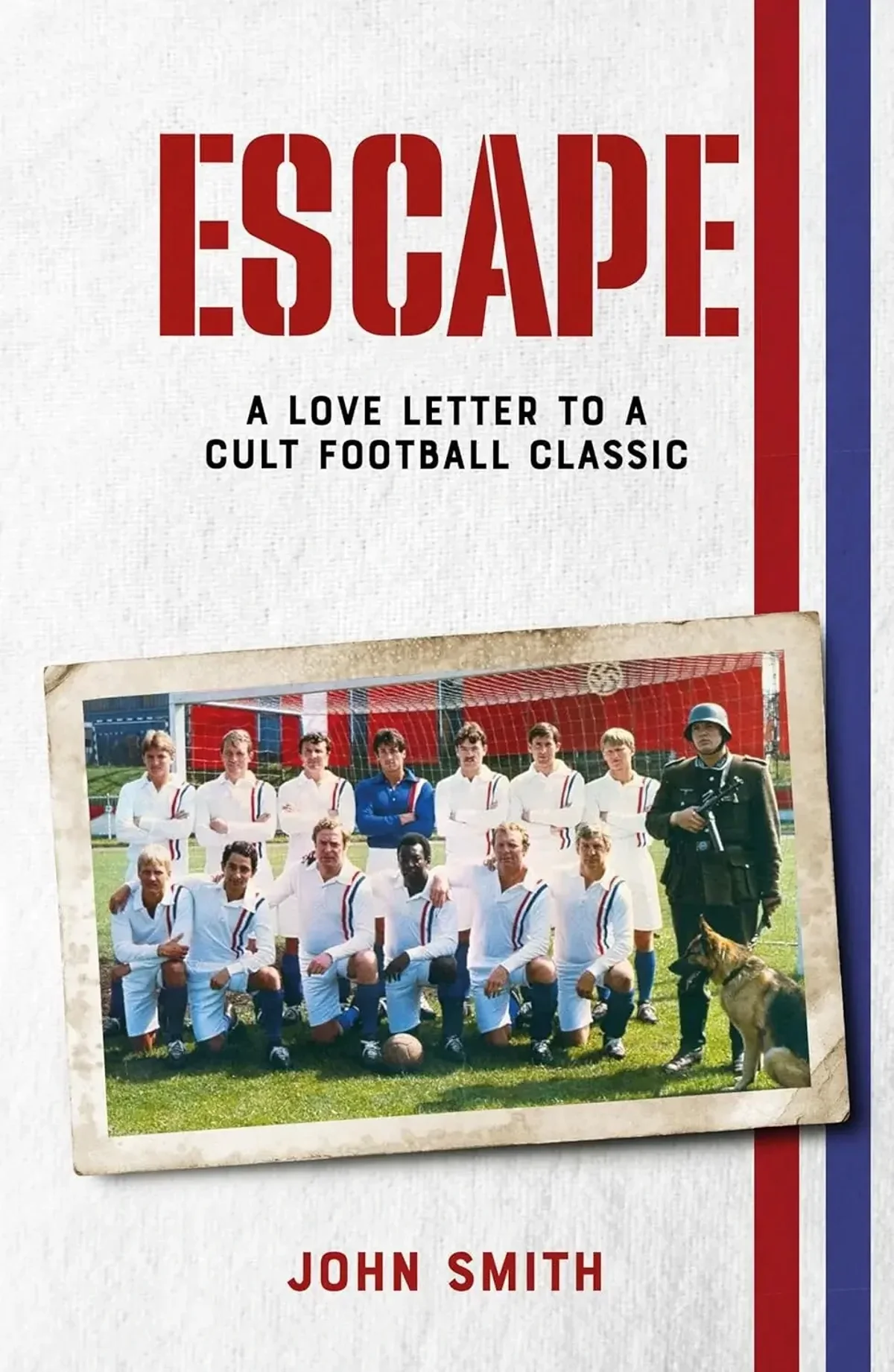
The old saying ‘Never judge a book by its cover’ is traditionally used as a warning, as if to do so is a bad thing, but in the case of my book 'Escape: A Love Letter to a Cult Football Classic', I don't mind if you do. The cover has got that famous white kit, with the parallel blue stripe and red stripe running down it, that will be so instantly recognisable to football fans, film fans, and specifically fans of 'Escape to Victory'. Whatever you might think of what's inside, and obviously I really hope that you like it, anyone familiar with that iconic kit, will have a fair idea of what they're getting into, as soon as they see it.

I found ‘Escape to Victory’ at a young age, in the nascent days of Home Video in the early eighties. We got a VHS player and ‘Videotheque’ arrived in our parade of shops, full of wonders with which to top load it. There, among copies of ‘Raiders of the Lost Ark’, ‘Blade Runner’ and other early picks for us that didn’t all have Harrison Ford in the lead, sat a curious cover featuring three men with arms raised in defiance. One of them was Sylvester Stallone, who I knew as Rocky; one of them was Michael Caine, who I was familiar with from a couple of films at least; and then, there, in the middle was Pele. What was this? Pele was the greatest footballer known to us at that time, but he wasn’t an actor, was he?
Closer inspection revealed a film that could best be described with a top line of ‘The Great Escape with Football’, and what’s not to love about that? I was already into the idea even before I found out Bobby Moore was also in it, and when Michael Caine’s character is revealed early on to be called John, AND to have played for West Ham, the deal was sealed for me. A lifelong love of the film began..
‘Escape to Victory’ is such a curio of a film, and it is my contention that there was a very small window when it could have been made, at least in the way that it was. Hollywood was not tripping over itself to make a film about football until Pele spent the mid-seventies playing for the very sexy New York Cosmos and raising the profile of the game in America more than ever before.
Attaching Pele was key to getting the film made and putting Sylvester Stallone back in another sports movie also made perfect sense for the producers. Michael Caine as Captain Colby and Max von Sydow as Major von Steiner, grounded the film and gave it a bit of gravitas, while the wild card choice of director, John Huston brought some old school Hollywood glamour and heritage to proceedings. But then we need to talk about the footballers that round out the Allies team, because that’s what really makes the movie what it is. Pele and Bobby Moore, were of course joined by the also retired Mike Summerbee, Co Prins and Paul van Himst, but the team also boasted actual current players of the day, Kazimierz Deyna, Hallvar Thoresen, Soren Lindsted and of course World Cup winner, Ossie Ardiles. And then there were the Ipswich lads.

Ipswich Town were in their golden period when the film was made in the summer of 1980. They were still fresh from winning the 1978 FA Cup, regulars in Europe, not too far from the summit of the Division One Table, and a year away from winning the UEFA Cup. Manager Bobby Robson knew a man called Peter Mason who had been hired by the film’s producers as a football consultant and that relationship led to Mason visiting Portman Road as part of his recruitment drive. He was ushered into a team meeting and asked who fancied coming to Hungary for the summer to appear in a film. Those who put their hands up were John Wark, Russell Osman, Kevin O’Callaghan, Kevin Beattie, Laurie Sivell, Robin Turner and Paul Cooper and off they went. One or two were due at the European Championships that summer, and a few more simply preferred their home comforts, but seven adventurous spirits headed off to a film set just outside Budapest.
It seems unthinkable that in the modern age, current players in the prime of their careers could be persuaded to do such a thing for a few extra quid, or more pertinently be allowed by their clubs and their insurance companies to spend the summer playing football on hard dusty pitches wearing army boots and risking injury, but in the carefree days of 1980, they were allowed to do so with the blessing of their clubs and their managers.
Paul Cooper and Kevin Beattie had to content themselves with being body doubles, for Stallone and Caine respectively, while Laurie Sivell and Robin Turner were recruited for the German team in the climactic game, which took place at Budapest’s MTK Stadium, standing in for Stade de Colombes in Paris. Meanwhile, Osman, O’Callaghan and Wark, were pushed front and centre as members of the Allies squad, and moreover, they were given lines and scenes to share with the acting legends among the cast.
At some point in the film’s process the decision was made to use real footballers and let them do some acting, rather than use actors and try to teach them how to play football. The result is that while some of the acting may leave a little to be desired, the football is as authentic as you could wish to see in the movies. That this is the case is due in part to the skills and ability of the plays, but also in part due to their influence on the production.
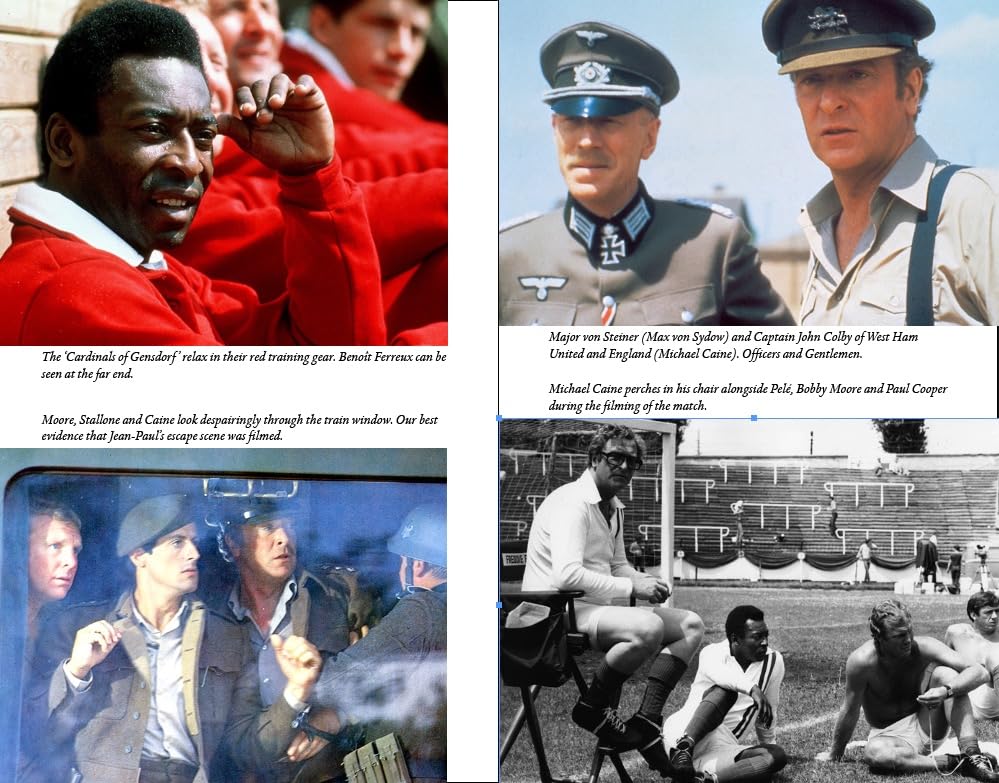
Producer Freddie Fields and Director John Huston didn’t know much about the game of football between them, but Fields had the presence of mind to bring in someone he thought did to help him. Robert Riger was a sports director on ABC’s ‘Wide World of Sports’ but unfortunately that world wasn’t wide enough to include football. Keen to make it work anyway, Riger did his due diligence and arrived on set with a huge dossier of storyboarded shots he required the footballers to recreate for his vision. The players took a look and set things straight by insisting that a far better approach would be to let them play in short bursts of five or ten minutes, give them a rough idea of what was required and simply capture what they did to edit it later.
Obviously, there were a few set pieces that were required to happen, such as the penalties and Pele’s memorable overhead kick, but aside from that, the word of the players was heeded, and what we are left with is the most convincing football committed to film, with tackles flying in, some natural movement and passing moves galore.
Furthermore, the footballers, led by Pele and Bobby Moore, were also able to point out that the original scripted finale to the film, which involved Stallone’s Hatch running up field with the ball and scoring the winning goal was a bit daft. With admirable flexibility, Stallone, Huston and Fields all accepted the change, and downgraded Hatch’s heroics to (spoiler alert) a last-ditch penalty save to keep things level at 4-4. It is to Sylvester Stallone’s credit that he accepted this change and, if you’ll forgive me, rolled with the punches.
Stallone’s status on set was something of a mixed bag, however. While some enjoyed his company and appreciated his experience, others felt that he was a bit aloof and prone to occasional diva behaviour. Famously he was brought down to earth a bit when Kevin Beattie beat him at arm wrestling.
It’s possible that any distance Sly put between himself and the rest of the cast was so keenly felt because the rest of the group was pretty tight knit. Throughout my interviews for the book, there was a recurring theme of ‘the footballers wanted to be actors and the actors wanted to be footballers’, and even if that slightly exaggerates how they felt, it certainly seems true that there was a great deal of mutual respect.
Hopefully, that sense of camaraderie and enthusiasm comes through in abundance in ‘Escape: A Love Letter to a Cult Football Classic’. It is full of tales of the football on set and the socialising off of it. It tells the tale of how the film came to be in the first place, and what it represents now to generations of football and film fans. Everyone I spoke to about their time on the film, spoke of how much they enjoyed making it, I certainly enjoyed writing about it, and hopefully some of you can enjoy reading about it.
Victoire!
John Smith – May 2026
John Smith is the author of ‘Escape: A Love Letter to a Cult Football Classic’
(Pitch Publishing) which is available to buy now in all the usual places. John has also previously written ‘Booked!’
and ‘Second Yellow’
(with Dan Trelfer) and ‘Final Third!’ which looked at the very best stories from well over 300 football autobiographies.



Thank you for posting your blog comment. It will be reviewed and set live soon. If you provided your email then you will be notified of replies to this comment.