
Burnden Park: The Story of Bolton Wanderers’ Legendary Old Home
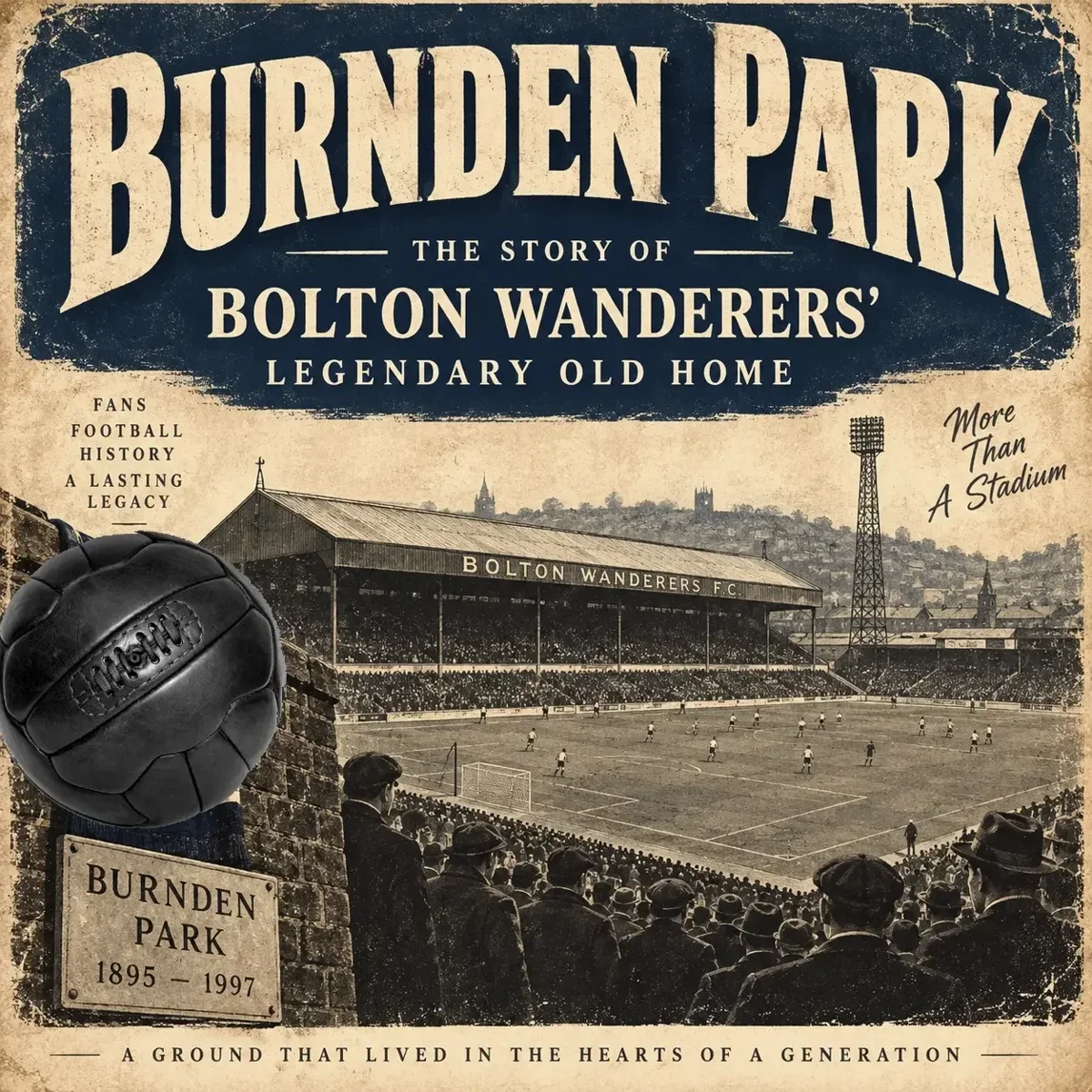
For more than a century, Burnden Park was much more than a football ground. It was the home of Bolton Wanderers, a meeting place for generations of supporters and one of the most recognisable football grounds in Lancashire.
Situated on Manchester Road in Bolton, Burnden Park witnessed some of the most memorable moments in the history of the Wanderers. Great victories, huge crowds, famous players, tragedy and changing football culture all played their part in the story of this remarkable old stadium.
Although Burnden Park disappeared from the football landscape in the late 1990s, its name remains deeply woven into the identity of Bolton Wanderers.
Today, memories of the ground live on through photographs, stories, artwork and football memorabilia — including the Burnden Park-inspired collection at Football Art Online.
Explore the Bolton-Inspired Art, Gifts & Clothing Collection
When Did Bolton Wanderers Move to Burnden Park?
Bolton Wanderers had already established themselves as one of England's important football clubs before Burnden Park opened.
The club was founded in 1874 as Christ Church FC before becoming Bolton Wanderers in 1877. The Wanderers were also among the original members of the Football League when the competition began in 1888.
By the early 1890s, however, the club needed a more suitable permanent home.
The answer was Burnden.
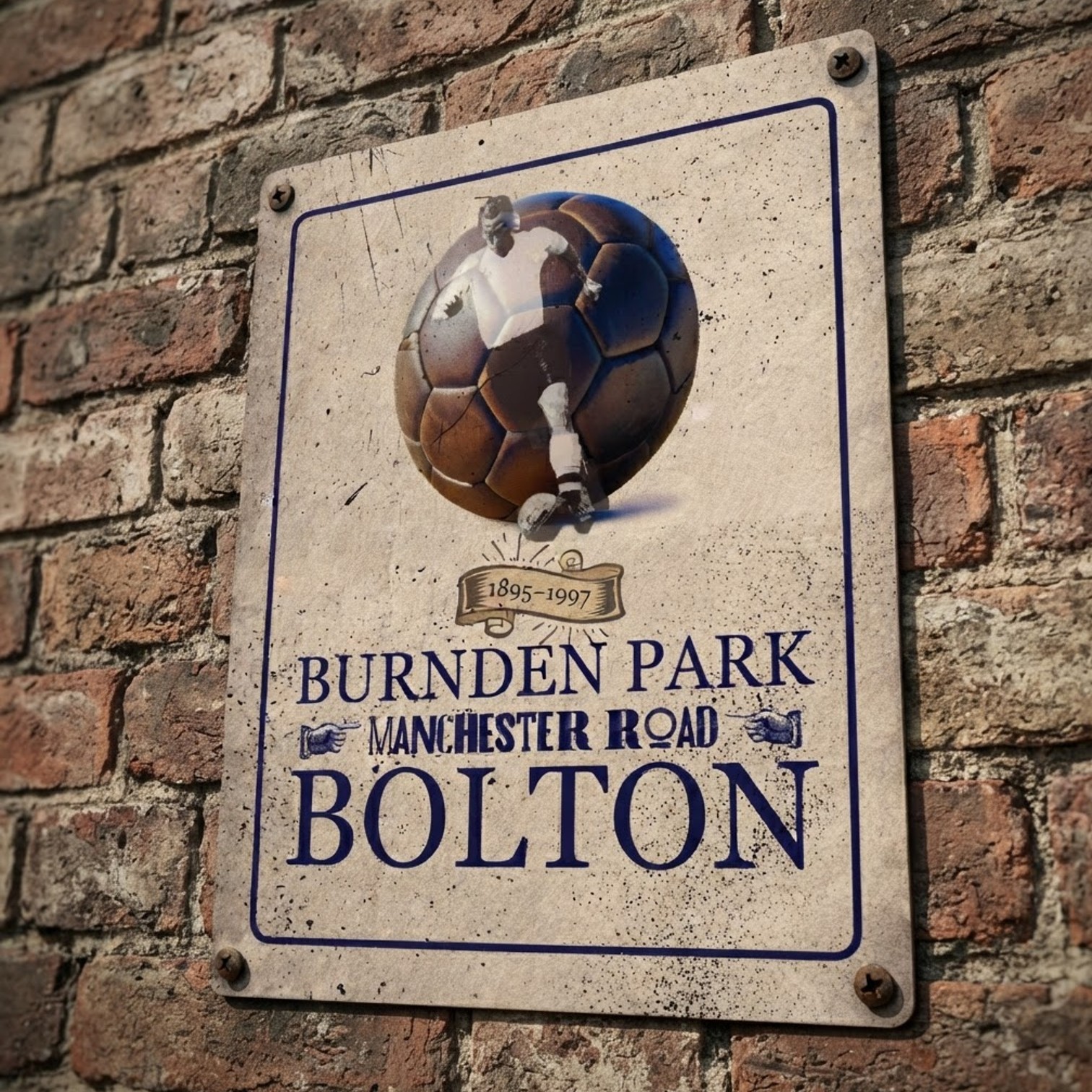
Land was secured in the Burnden area of Bolton and a purpose-built football ground was developed. Burnden Park was completed in 1895, with its opening taking place that August.
The new ground represented an important step forward for Bolton Wanderers. Instead of simply having a place to play football, the club now had a home capable of growing alongside the increasing popularity of the sport.
The first match at Burnden Park was a benefit fixture against Preston, while Bolton's first Football League match at the ground was against Everton.
From these relatively modest beginnings, Burnden Park would eventually become capable of accommodating tens of thousands of supporters.
The Rise of a Famous Football Ground
Football was becoming increasingly popular across Britain during the late Victorian and Edwardian eras, and Bolton was at the heart of that growth.
Burnden Park developed considerably over the decades. Terracing allowed increasingly large numbers of spectators to attend matches, while the ground became an important part of everyday life for football supporters in the town.
It was not simply somewhere people visited for 90 minutes.
For many Bolton families, going to Burnden Park became a tradition passed from one generation to the next.
The ground's enormous capacity reflected the popularity of football during the first half of the twentieth century. At its peak, Burnden Park could accommodate around 70,000 spectators, although later safety regulations and redevelopment resulted in a much smaller capacity.
One of the ground's most memorable early occasions came in 1901 when it hosted the replay of the FA Cup Final between Sheffield United and Tottenham Hotspur.
Tottenham won 3–1, becoming the first non-League club to lift the FA Cup.
For Bolton supporters, though, some of Burnden's greatest footballing memories were still to come.
Bolton Wanderers and the Famous 1923 FA Cup Final
Burnden Park itself did not host the 1923 FA Cup Final, but its significance to Bolton Wanderers history can hardly be separated from the club's extraordinary triumph that year.
Bolton reached the inaugural FA Cup Final at the newly opened Wembley Stadium, facing West Ham United.
The match became one of the most famous games in English football history.
An enormous crowd gathered at Wembley, with spectators spilling onto the pitch before kick-off. A mounted police officer, PC George Scorey, became famous for helping to clear the playing area with his grey horse, Billie.
The match subsequently became known as the White Horse Final.
Bolton won 2–0, with goals from David Jack and Jack Smith, securing the first of the club's FA Cup triumphs.
For Bolton supporters, the success became a defining chapter in the club's history — and the players returned to a town where Burnden Park was already becoming a central part of Wanderers life.
The Burnden Park Disaster of 1946
Burnden Park's history also contains one of the darkest days in British football.
On 9 March 1946, Bolton Wanderers hosted Stoke City in an FA Cup sixth-round second-leg match.
The attraction of seeing Stoke's legendary player Stanley Matthews, combined with the excitement surrounding the FA Cup, brought a huge crowd to Burnden Park.
Around 85,000 people are estimated to have attended.
The ground was severely overcrowded.
During the match, two steel crush barriers on the packed Embankment terrace collapsed. The pressure of the crowd caused people to fall forward, resulting in a terrible crush.
Thirty-three people lost their lives and hundreds more were injured.
The tragedy became known as the Burnden Park disaster and remains one of the most painful episodes in the history of Bolton Wanderers.
What happened at Burnden Park also became part of the wider history of football safety in Britain. The disaster demonstrated the potentially devastating consequences of overcrowding and inadequate crowd-control arrangements.
For Bolton, the names and memories of those who died remain an important part of the story of the club and the town.
The tragedy should never be allowed to disappear from the history of Burnden Park.
Burnden Park and L.S. Lowry's 'Going to the Match'
Perhaps no work of art has captured the atmosphere of traditional British football quite like L.S. Lowry's Going to the Match.
Painted in 1953, the famous work depicts supporters making their way towards a football ground.
The ground shown is Burnden Park.
Lowry's painting is significant because it captures something that statistics and match reports cannot: the ritual of going to the football.
The crowds, rows of houses, industrial surroundings and anticipation of match day create a remarkably recognisable picture of northern football culture.
It is one of the reasons Burnden Park remains important beyond Bolton Wanderers supporters. The ground became part of Britain's wider cultural and artistic history.
The painting has subsequently become one of the most famous football artworks ever created.
For anyone interested in vintage football art, old football grounds and the history of match-day culture, Lowry's depiction of supporters heading towards Burnden Park remains particularly powerful.
The Changing Face of Burnden Park
Football changed considerably during the second half of the twentieth century, and Burnden Park changed with it.
The huge crowds of earlier decades became less common, while changing regulations and the decline of traditional terracing affected the stadium's capacity and appearance.
The ground gradually became more dated.
One major change came in 1986 when part of the Railway Stand was sold to make way for a supermarket development.
For supporters who remembered Burnden at its busiest, the transformation represented a visible sign that the traditional football ground was disappearing.
Yet the stadium continued to host important Bolton Wanderers matches.
Burnden Park remained capable of producing memorable occasions, including FA Cup ties and dramatic league matches.
The ground was still home.
Burnden Park's Final Years
By the 1990s, the future of Burnden Park was becoming increasingly uncertain.
The Hillsborough disaster in 1989 and the subsequent Taylor Report accelerated the transformation of English football grounds, with top-level clubs moving towards all-seater stadiums.
For Bolton Wanderers, developing Burnden Park into a modern stadium was considered, but ultimately the club decided that a new ground offered a better long-term solution.
That meant the end of an era was approaching.
Bolton's final season at Burnden Park was the 1996–97 campaign.
It was an appropriately memorable season.
Managed by Colin Todd, Bolton produced an outstanding campaign and won the First Division title with 98 points and 100 goals, earning promotion back to the Premier League.
The club's final competitive match at Burnden Park came against Charlton Athletic in April 1997.
Bolton won 4–1.
John McGinlay scored the final goal at the famous old ground.
There could hardly have been a more fitting farewell: a convincing victory, a league title and promotion secured, and generations of memories coming to an end.
The End of Burnden Park
Bolton Wanderers subsequently moved to the new stadium at Horwich, originally known as the Reebok Stadium, in 1997.
The club's first match at the new stadium was against Everton in September 1997.
The move marked a dramatic change for the Wanderers.
The new stadium offered modern facilities and an all-seater environment, but for many supporters it could never completely replace the character of Burnden Park.
The old ground had been part of Bolton for 102 years.
Eventually, Burnden Park was demolished and the site was redeveloped.
The physical stadium disappeared, but the name did not.
Why Is Burnden Park Still Important?
Ask a Bolton Wanderers supporter about Burnden Park and you are unlikely to hear only a description of stands, terraces and turnstiles.
You will hear stories.
Stories about going to matches with parents and grandparents.
Stories about enormous crowds.
Stories about legendary players.
Stories about FA Cup glory.
Stories about the atmosphere.
And, inevitably, stories about the tragedy of 1946.
That is what makes the history of Burnden Park so fascinating.
It represents the full story of traditional English football: triumph and disappointment, community and rivalry, nostalgia and change.
The stadium was part of the fabric of Bolton itself.
Remembering the Burnden Park Era
Although Burnden Park no longer stands, its legacy continues through football history, photography, paintings and memorabilia.
For supporters who remember the ground, and for younger fans discovering the history of Bolton Wanderers, vintage-inspired artwork can provide a way of keeping that connection alive.
At Football Art Online, the Bolton-inspired collection celebrates the heritage and visual character associated with Bolton football and Burnden Park.
The range is designed for supporters looking for Bolton football wall art, vintage Bolton gifts, Burnden Park-inspired artwork, retro football gifts and football-themed home décor.
You can explore the collection here:
Bolton-Inspired Art, Gifts & Clothing – Football Art Online
You can also discover the wider collection of football artwork, prints, gifts and fan-inspired products at:
A Football Ground That Became Part of History
Burnden Park may have disappeared physically, but it remains one of the most recognisable names in Bolton Wanderers history.
From its opening in 1895 to its final match in 1997, the ground witnessed more than a century of football.
It saw huge crowds and historic matches. It was connected to FA Cup history, remembered through one of Britain's most famous paintings and marked forever by the terrible events of 1946.
Most importantly, it was somewhere that generations of Bolton supporters called home.
Modern football stadiums may offer better facilities, greater comfort and impressive architecture, but old grounds such as Burnden Park had something that cannot easily be recreated.
They were woven into the communities around them.
For Bolton Wanderers supporters, Burnden Park is therefore not simply an old football ground.
It is a memory.
It is part of the club's identity.
And it is a piece of football history that deserves to be remembered.


Thank you for posting your blog comment. It will be reviewed and set live soon. If you provided your email then you will be notified of replies to this comment.